How fast do you have to reply to a countertop lead?
Five minutes. Not "same day", not "first thing tomorrow". The measured decay is steep enough that a half-hour delay costs you most of the lead - and the lead usually arrives while you are under a slab with a grinder in your hand.
Reply within five minutes. The Lead Response Management study - Professor James Oldroyd of MIT, three years of data, six companies, 15,000+ leads, 100,000+ call attempts - found a 21-fold decrease in the odds of qualifying a prospect when response time went from 5 minutes to 30, and a fourfold drop between 5 and 10 minutes. When you reply mattered more than what day or hour it was.
Almost every shop owner already agrees that replying quickly is good. Almost none of them treat five minutes as a hard operational number, because it sounds like advice for call centres rather than for a business with two people and a bridge saw.
The reason to take it literally is the shape of the decay. It is not a gentle slope where a two-hour reply is a bit worse than a ten-minute one. Most of the damage happens inside the first half hour.
What the research actually found
The most-cited work here is the Lead Response Management study, conducted with Professor James Oldroyd, then of MIT, using datasets from InsideSales.com. The methodology is unusually solid for a marketing statistic: three years of data from six diverse companies, more than fifteen thousand leads and over a hundred thousand call attempts.
Figures read from leadresponsemanagement.org on 5 August 2026. The study also found response timing outweighed both the day of the week and the time of day in significance.
This research gets quoted loosely. You will see "100x more likely to connect" attached to it, and a set of figures credited to a 2011 Harvard Business Review article by the same lead author. We are only quoting what we could read at source. The HBR piece is paywalled, so its numbers are not on this page even though they are widely repeated. If a statistic matters to a decision you are making, find the study, not the infographic.
Why this is worse in countertops than in most trades
A homeowner redoing a kitchen does not contact one fabricator. They open three or four tabs, fill in three or four forms in the same twenty minutes, and then go back to their evening.
That creates a race with a specific and unforgiving structure. The first shop to reply gets to book the measure. Once a measure is booked, the homeowner mostly stops shopping - they have a person coming to the house, the task feels handled, and the remaining shops are replying into a decision that has already been made.
This is also why slow shops misread their own numbers. They see leads that "went quiet" or "were just price shopping" and conclude the lead source is poor. Often the lead was fine and somebody else got there in nine minutes.
The problem: you are holding a grinder
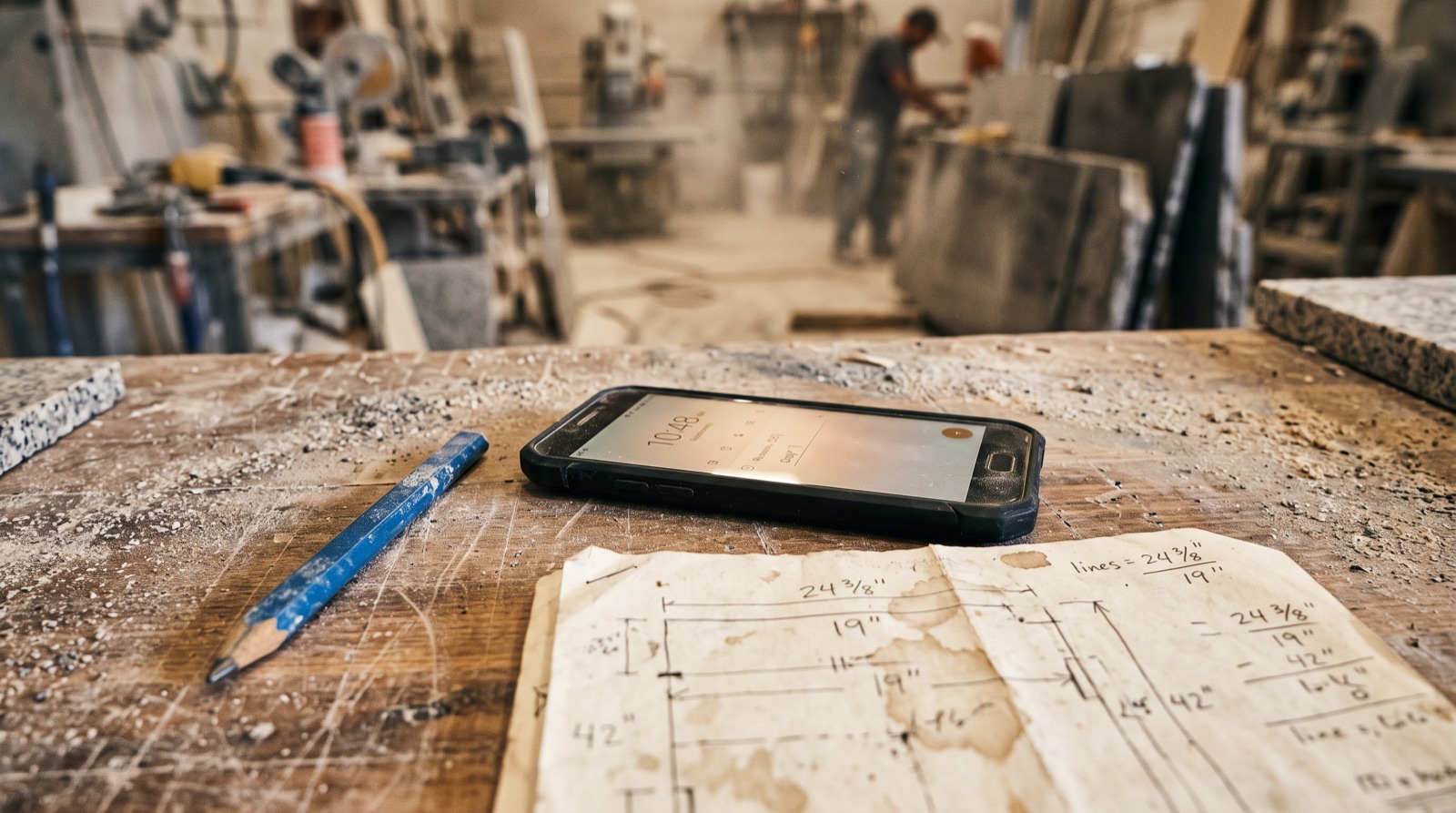
Here is the honest difficulty, and the reason most advice on this topic is useless to a small fabricator. The people capable of answering a countertop enquiry properly are the same people cutting stone. You cannot hear a phone over a saw, you cannot answer a form fill with wet hands, and at 7pm on a Tuesday nobody is at a desk at all.
Leads, meanwhile, arrive disproportionately in the evening and at weekends, because that is when people plan kitchens. So the busiest lead hours and the emptiest office hours are the same hours.
Telling a two-person shop to "respond faster" does not survive contact with that reality. The only things that work are structural.
What actually works
- An instant automatic reply on every form fill and missed call. A text within seconds that says a real person has it and asks one useful question. This is the single highest-leverage change available to most shops, and it costs almost nothing.
- Missed-call text-back. If you cannot answer, the caller gets a text immediately rather than voicemail. Most people under 50 will not leave a voicemail and will simply call the next shop.
- One place every lead lands. Form fills, calls, Google messages and Facebook messages in one inbox someone actually watches. Leads die in channels nobody has opened since March.
- Evening and weekend cover. An answering service, a family member with a phone, or an AI assistant that can hold a sensible conversation and book a measure. This is where most of the missed opportunity sits.
- A booking link in the first reply. Removing the back-and-forth about times converts far better than promising to "get something in the diary".
Replying in five minutes will not save a bad offer, a wrong price or a shop with no reviews. It gets you into the conversation - it does not win it.
It is also worth being clear that the first reply should not contain a price. Its job is to prove a human has the enquiry and to book the measure. A number quoted before you know the material, square footage, edge profile and cutouts is either a guess you will have to retract or a figure that loses the job for no reason.
What this looks like in our own numbers
We run this system at BedRock Countertops in Calgary, which is our own shop and our proof. Over a 30-day window it produced 48 leads at about $30 each, and 54% of those leads booked a measure.
Two honest caveats on that, which we would want attached anywhere it is quoted. It is one shop, one city, one month - a data point, not a benchmark. And a 54% measure rate is the output of the whole system, not of reply speed alone: the ads, the offer, the quote page and the follow-up all move that number. We cannot isolate speed from the rest, and we are not going to pretend we can.
What we can say is that the leads arriving at 9pm are the ones that would previously have gone unanswered until the following afternoon, and by then they belong to somebody else.
How to test your own response time this week
- Have someone who is not you fill in your own website quote form at 8pm on a weekday. Time the first reply. Not the first human reply - the first anything.
- Call your own number during a fabrication shift and let it ring out. See what the caller gets.
- Send a message through your Google Business Profile. Many shops do not know this inbox exists.
- Do the same on the two competitors nearest you, and see what you are actually up against.
Most shops that run this test find at least one channel where the answer is "nothing, ever". That channel is not a marketing problem, it is a plumbing problem, and it is usually fixable in an afternoon.
Fast follow-up is part of what we sell, so read this with that in mind. Everything above is doable without us - missed-call text-back and an auto-reply are available in plenty of cheap tools, and we would rather you fix this on your own than not fix it. What we sell is the whole machine: the demand, the quote page, the board and the follow-up that runs at 9pm. See the order those should happen in.
Common questions
How fast should you respond to a countertop lead?
Within five minutes. The Lead Response Management study with Professor James Oldroyd of MIT - three years of data, six companies, over 15,000 leads and 100,000 call attempts - found a 21-fold decrease in the odds of qualifying a prospect when response time stretched from 5 to 30 minutes, and a fourfold drop between 5 and 10 minutes. Timing mattered more than the day of the week or the hour.
Why does it matter so much for countertop quotes specifically?
Because homeowners planning a kitchen contact three or four shops in one sitting. The first to reply books the measure, and once a measure is booked most people stop shopping. You are competing on who answers, not on price or craftsmanship.
How can a two person shop reply in five minutes?
Not manually. The realistic answers are an instant automatic text on every form fill and missed call, missed-call text-back instead of voicemail, one inbox that collects every channel, and evening or weekend cover from an answering service or an AI assistant. The goal is a human-sounding first response inside five minutes, not a finished quote.
Should the first reply include a price?
No. The job of the first reply is to show a real person has the enquiry and to book the measure or a call. A price given before you know the material, square footage, edge profile and cutouts is either a guess you will have to walk back or a number that loses the job unnecessarily. See what a lead actually costs for the money side.
When do countertop leads actually come in?
Disproportionately evenings and weekends, because that is when people plan kitchens. That is exactly when a small shop has nobody at a desk, which is why evening cover is usually the biggest single improvement available to a shop's booking rate.